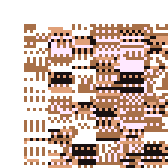
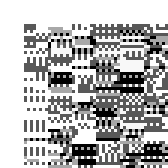
p, glitch Pokemon index CB (203) of Pokemon Red and Blue
The whole name is a single lowercase p. Not a word, not a smear of symbols, just one letter left standing like the first keystroke of a name nobody finished. It is the plainest label in the catalogue, and it sits on top of one of the most instructive accidents in it.
Index 203 borrows the data of a real bird. Its shown species is 17, Pidgeotto, so it takes on clean Normal and Flying typing, sensible stats around the low sixties, a catch rate of 120, and the exact opening moves a Pidgey line carries, Gust and Sand-Attack. On paper it is a perfectly ordinary bird you could catch on Route 1. And yet its face is broken, a scramble of stray cartridge bytes instead of feathers.
Here is why, and it is the key to half the creatures in this wing. The game reads a Pokemon's stats and moves from a table indexed by species, but it chooses which bank of the cartridge holds the sprite by the raw index number instead. P borrows Pidgeotto's soul but keeps its own index's address book, so the game looks for a Pidgeotto sprite in a drawer that holds something else entirely. The result is a creature that is statistically a bird and visually a mess. Its evolution data is nine entries the game cannot read, so it never evolves, but the real lesson of P is quieter: in Red and Blue, what a thing is and what a thing looks like are stored in two different places, and the glitches are what happen when those two places disagree.
NORMAL FLYING
The bytes
| What | Where in the ROM | Value |
|---|---|---|
| Index number | slot 203 of the species table | 0xCB (203) |
| Pokedex byte | 0x410EE | 17 (borrowed from a real species) |
| Stats entry | 0x3859E | 11 3F 3C 37 47 32 00 02 78 71... |
| Size byte | entry byte 10 | 0x66 = 6 wide, 6 tall (the buffer holds 7x7) |
| Name bytes | 0x1CA02 | 19 2A 47 7E 4F 21 AF D3 CD 0D |
| Catch rate | entry byte 8 | 120 |
Front sprite pointer 0x780A resolves into ROM bank 0x0D (deterministic) at file offset 0x3780A. The decode is deterministic: it looks the same on every cartridge, every time.
Byte for byte identical in Blue, except for its front and back pictures. Both are read from bank 0x0D, and the bytes they run through there are not all the same in Blue, so Blue draws them with different static.
Base stats
Moves
Knows from the start: GUST, SAND-ATTACK.
Learnset (read straight from its pointer)
10 entries, in the order the game reads them. 8 of them are filed past level 100, so they never arrive.
| Level | Move |
|---|---|
| L6 | POISON STING |
| L119 | MEGA KICK |
| L5 | HORN DRILL |
| L251 | GLITCH MOVE 0xC9 |
| L234 | GLITCH MOVE 0xE9 |
| L206 | GLITCH MOVE 0xF0 |
| L184 | GLITCH MOVE 0xF5 |
| L250 | GLITCH MOVE 0xE9 |
| L206 | GLITCH MOVE 0xE0 |
| L184 | GLITCH MOVE 0xEA |
TM and HM compatibility (flag bits, entry bytes 20 to 26)
| Machine | Move |
|---|---|
| TM02 | RAZOR WIND |
| TM04 | WHIRLWIND |
| TM06 | TOXIC |
| TM09 | TAKE DOWN |
| TM10 | DOUBLE-EDGE |
| TM20 | RAGE |
| TM31 | MIMIC |
| TM32 | DOUBLE TEAM |
| TM33 | REFLECT |
| TM34 | BIDE |
| TM39 | SWIFT |
| TM43 | SKY ATTACK |
| TM44 | REST |
| TM50 | SUBSTITUTE |
| HM02 | FLY |
Evolutions
None. Its pointer, $0092 in ROM bank 0, leads to 9 entries, and not one has a method byte the game acts on (1 for level, 2 for item, 3 for trade). It skips them all, so this creature never evolves.
A bird taught by the sprite code
Its evolution pointer, $0092, lands in ROM bank 0 inside HideSprites, the tiny routine that moves every sprite below the bottom of the screen. The game reads those instructions as evolution data, finds nine entries it cannot use, and stops. Then it reads the same bytes again, from a few steps further in, as a learnset.
Built as a bird, drawn as noise, and schooled by the code that hides sprites. It has the plainest name in the catalogue and one of the strangest files behind it.
Hear its cry
Its base, 0x17, is one of the game's 38 real cries, played at this specimen's own pitch and length, so the button below rebuilds it live from those three bytes. It is not a recording.
Does it still work?
| Where | Still works? |
|---|---|
| Original Game Boy cartridge | Yes. |
| Game Boy Color / Super Game Boy | Yes. Red and Blue send their colors only to a Super Game Boy. In battle it wears palette 0x15, shown above; its status screen uses Rhydon's gray palette, as it does for every index past 190. |
| 3DS Virtual Console (2016 re-release) | Yes. |
| Later remakes (FireRed, Let's Go, and newer) | No. |
Why these answers hold, and how every number on this page was read from the ROM: how these pages are made.
Fight it yourself
In the real game you can never meet it in the wild: any encounter that asks for index 203 starts a battle against a Lass instead.
Related specimens
Part of The Glitchhouse.